SHADEWATER LABS

Research

Research from Shadewater Labs on how attention, effort, and daily functioning change from one day to the next in ADHD.

Research perspective · ADHD

Physiological State and Executive Function in ADHD

Alex Yesilcimen

Read the paper (PDF)
Full integrated research edition · 188 pages · 10.2 MB

Why might the same person find a task harder on one day than another? The paper proposes a way to measure changes in attention, effort, and daily functioning. It starts with a proposed sleep study in adults with ADHD and a comparison group.

The full edition includes the illustrated manuscript, evidence reviews, and proposed study methods. It is a research perspective with no original participant data or independent peer review.
Proposed research

Study at a glance

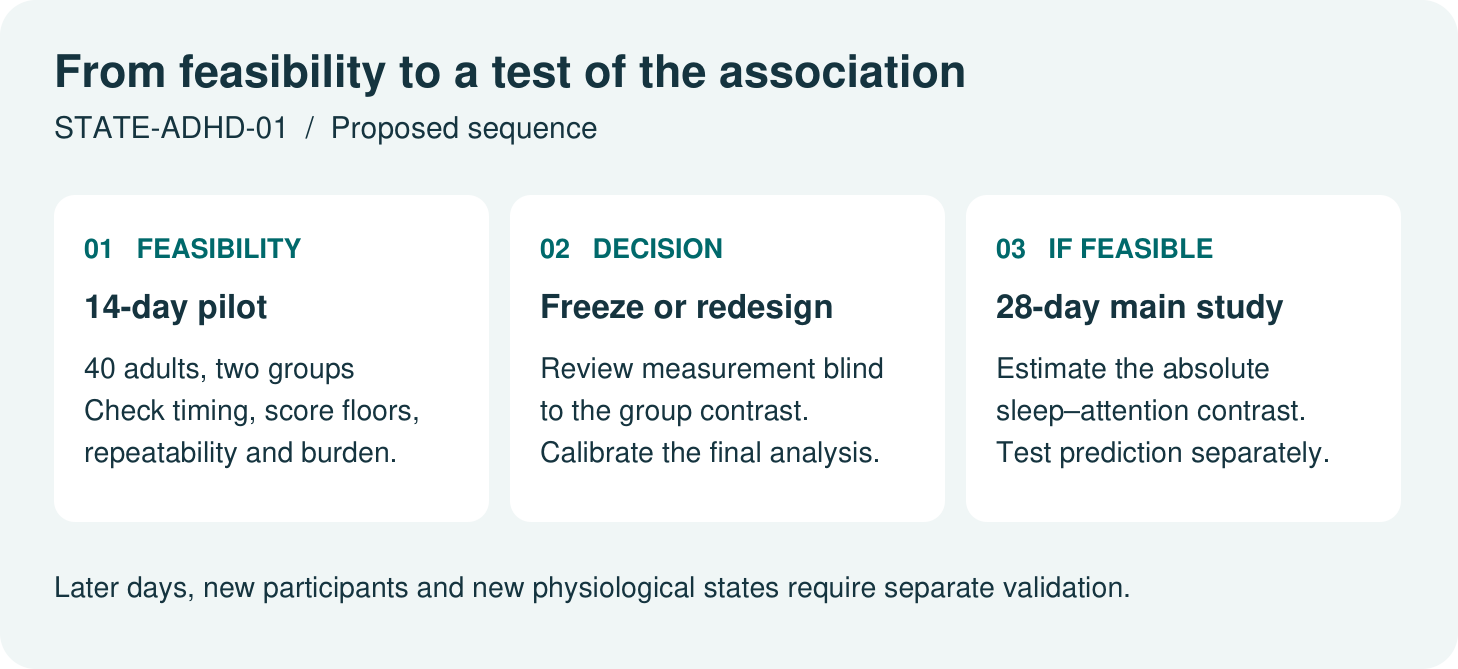
  1. 14-day pilot. Check whether adults can record their sleep and complete brief attention tests reliably in everyday life.
  2. 28-day study, if the pilot checks pass. Compare how missed targets on the attention test change after shorter nights in adults with ADHD and in the comparison group.

Optional deadline task. Track a recurring task participants already do and test whether estimated time to spare helps predict missed deadlines.

Proposed study sequence. The team reviews pilot measurements without seeing the difference between groups, then finalizes the design or revises it before proceeding.
Study sequence in the manuscript (Figure 30, PDF p. 21)
Read the pilot methods (Appendix L, PDF p. 130)

Start here

Start with the example, then follow the evidence and the proposed study. These page numbers match the November PDF.

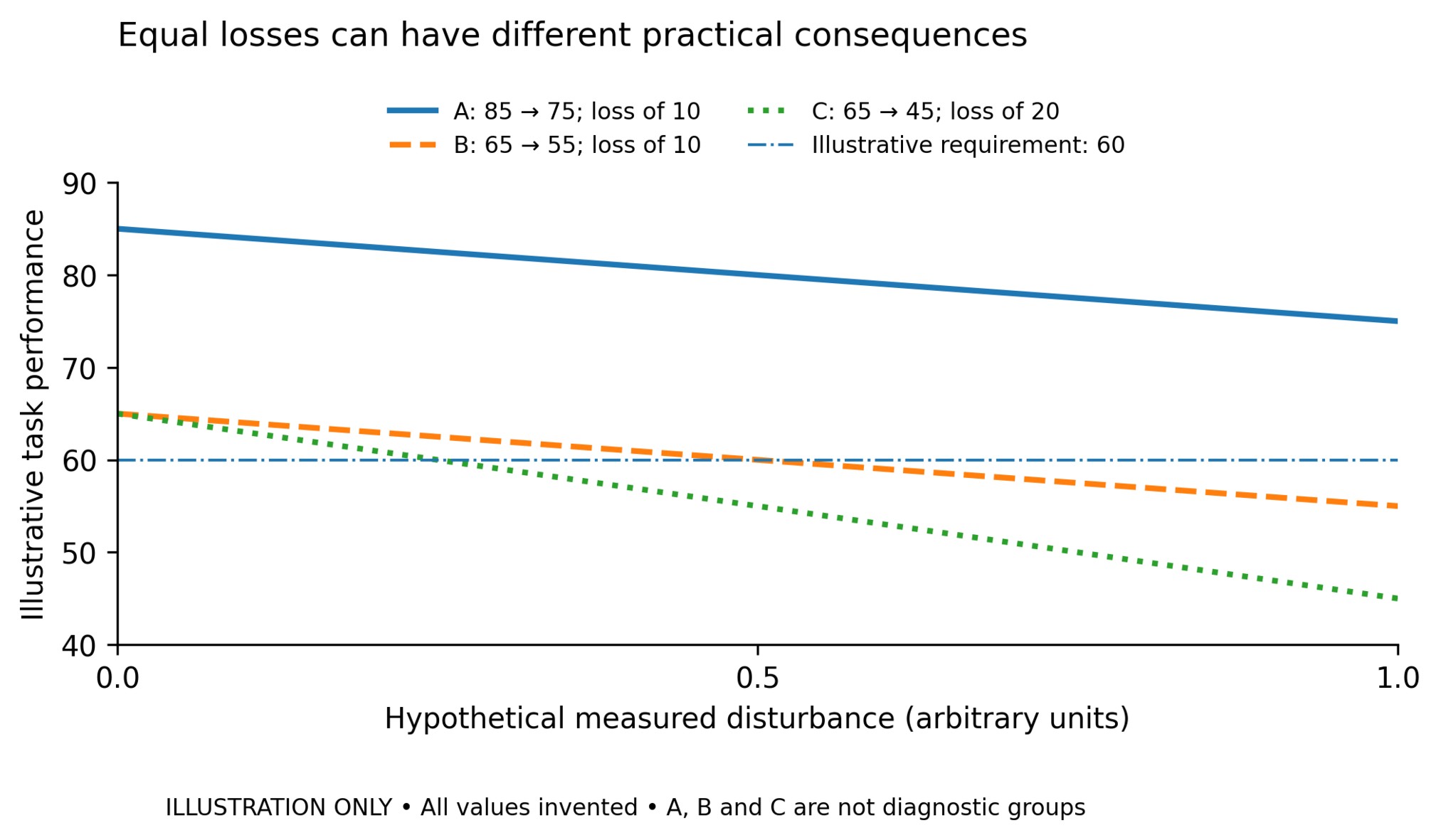
Figure 1. The same drop can have different effects

Line chart showing three hypothetical changes in task performance against a 60-point requirement.
Hypothetical values for illustration. A, B, and C do not represent diagnostic groups. View Figure 1 in the paper (PDF, p. 10)

The task requires 60 points. A and B both lose 10 points, but A goes from 85 to 75 and still meets the requirement, while B goes from 65 to 55 and falls below it. C starts at 65, just like B, but drops to 45. B had less room to lose points than A, while C’s score was more sensitive to the same change.

Key terms

Functional margin
A person’s margin is the gap between their current performance and what a specific task requires.
Bodily reactivity
This describes how strongly the body responds to a given challenge.
Cognitive sensitivity
This describes how much thinking or task performance changes for a given amount of bodily change.
Recovery
This describes how a measured outcome returns toward a defined level after a disturbance.
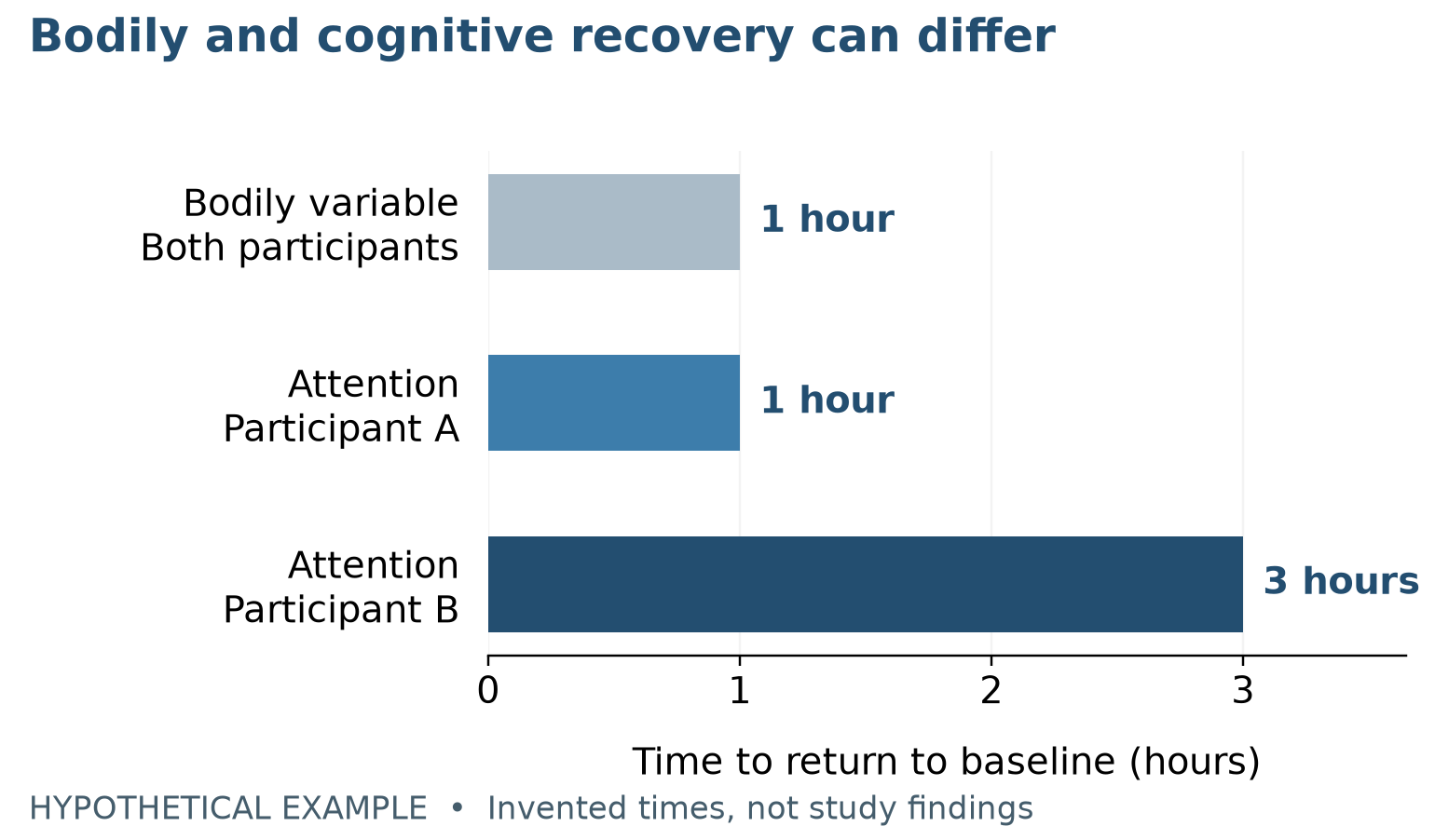
Hypothetical example. A bodily measure returns to its starting level in one hour for both people. Attention returns in one hour for one person and three hours for the other.
The chart uses invented times to show how attention and a bodily measure could recover at different rates. Read the worked example (PDF, p. 12)
Read the full glossary (PDF, p. 102)

What would change our minds?

  • What would warrant a follow-up. A clear, meaningful difference in how missed targets change after shorter nights would justify testing the sleep question under controlled conditions. What the results would justify (PDF, p. 25)
  • What would weaken the predictions. A precise, negligible sleep difference would narrow the attention claim. For the optional task, use the simpler model if the comparison rules out a worthwhile gain from estimating time to spare. Table 7A. How to interpret both results (PDF, p. 23)
  • What’s still open. Unreliable measurements or too few observations would leave either study question open. How strongly the body responds to a challenge and how long recovery takes require separate tests.

Source notes

Appendix I records which sources were checked and where questions remain. Read these journal notices alongside the studies.

Read the source audit (PDF, p. 120)

Suggest a correction

Include the edition, PDF page or reference number, what needs correcting, and a source link if you have one.

Email a correction

Cite this paper

Alex Yesilcimen. (November 9, 2026). Physiological State and Executive Function in ADHD: A framework for measuring attention and daily function across interventions (Full integrated research edition). Shadewater Labs. https://shadewaterlabs.com/research/physiological-state-and-executive-function-in-adhd-2026-11-09.pdf